About Me
- Russell Blackford
- Australian philosopher, literary critic, legal scholar, and professional writer. Based in Newcastle, NSW. My latest books are THE TYRANNY OF OPINION: CONFORMITY AND THE FUTURE OF LIBERALISM (2019); AT THE DAWN OF A GREAT TRANSITION: THE QUESTION OF RADICAL ENHANCEMENT (2021); and HOW WE BECAME POST-LIBERAL: THE RISE AND FALL OF TOLERATION (2024).
Thursday, August 19, 2010


X-Men: Legacy # 239 - why is Rogue so pissed off?
On another note, I'm intrigued by this scene from the forthcoming X-Men: Legacy #239. Rogue sure looks pissed off with Magneto about something. I wonder what (I can think of several good reasons she might have, given their past, but it'll probably turn out to be something else entirely). Magneto responds by looking ... what? Thoughtful? Contrite? Amused? Bemused? As opposed to, say, killing her, which has been his more usual response to opposition over the years. I'll have to pick up this issue, if only to find out what's actually going on here when the context and dialogue are provided.
 Bear in mind that these characters are somewhat different from their equivalents in the movies. You can click on the image to expand it, of course. It's one of several online to illustrate an interview with Mike Carey about X-Men Legacy - over here.

Lineup of authors and topics for The Australian Book of Atheism (Scribe, 2010, ed. Warren Bonett)
Chrys Stevenson, Felons, Ratbags, Commies and Left-Wing Loonies
Max Wallace, The Constitution, Belief and the State
Alex Stewart, Religion, and the Law in Australia
Robyn Williams, A Part-time Atheist
Dr Colette Livermore, Atheism: an explanation for the believer
Tanya Levin, Above Rubies
Hon. Lee Rhiannon, Growing up Atheist
David Horton, Agnostics are Nowhere Men
Tim Minchin, Storm
Hugh Wilson, Public Education in Queensland
Peter Ellerton, Theology is Not Philosophy
Professor Graham Oppy, Evolution vs Creationism in Australian Schools
Graeme Lindenmayer, Intelligent Design as a Scientific Theory
Kylie Sturgess, Atheism 2.0:
Dr Martin Bridgstock, Religion, Fundamentalism & Science
Dr Philip Nitschke, Atheism & Euthanasia
Alex McCullie, Progressive Christianity: A Secular Response
Dr Leslie Cannold, Abortion in Australia
Jane Caro, Why Gods are Man-Made
Dr Karen Stollznow, Spiritualism & Pseudoscience
Rosslyn Ives Life, Dying & Death
Hon. Ian Hunter MLC, Prayers in Australian Parliament
Lyn Allison, Ever Wondered Why God is a Bloke?
Michael Bachelard, Politics and The Exclusive Brethren
Dr Russell Blackford, Free Speech
Dr John Wilkins, The Role of Secularism in Protecting Religion
Warren Bonett, Why a Book on Atheist Thought in Australia?
Dr Robin Craig, Good without God
Ian Robinson, Atheism as a Spiritual Path
Professor Peter Woolcock, Atheism & the Meaning of Life
Dr Tamas Pataki, Religion & Violence
Dr Adam Hamlin, The Neurobiology of Religious Experience
Dr Rosemary Lyndall Wemm, The Neurology of belief
That's a powerful lineup, and Scribe is a very respected publisher. You can already pre-order from Embiggen Books, and you can have a look at the publisher's site for the book. The Australian Book of Atheism will be available in time for Christmas and might make an ideal gift for someone you know.
Skiffy and Mimesis
Damien Broderick's new book, Skiffy and Mimesis, which takes its title from an essay of mine that's included, is now available - or about to be by the time of the Worldcon (now only two weeks away).
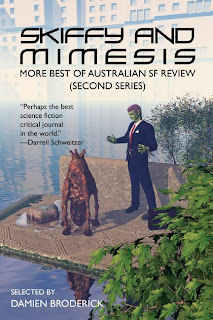 This book is a companion to Chained to the Alien. Between them, they reprint much of the best material in Australian Science Fiction Review, Second Series, the classic zine whose run went from 1986 to 1991 and managed to win a Ditmar Award towards the end. As one of the editors and most frequent contributors to the zine, I obviously have a vested interested in the two books that Damien has put together ... but please consider!
I still think that we had some exciting discussions back then, and that it's fascinating to read now, twenty-odd years later. Those were the days before the internet, before it was possible to be enbroiled in debate with an international cast every day. But the quality of discussion of Australian and international science fiction was, I believe, high, and the zine made some reputations.

I still think that we had some exciting discussions back then, and that it's fascinating to read now, twenty-odd years later. Those were the days before the internet, before it was possible to be enbroiled in debate with an international cast every day. But the quality of discussion of Australian and international science fiction was, I believe, high, and the zine made some reputations.
Wednesday, August 18, 2010
Felix nominated for Best Fannish Cat
Felix Blackford (or, more correctly Mystical Prince Felix), is shortlisted for Best Fannish Cat, a special award of the Australian national sf convention. If you're a member of the convention, don't forget to vote.
Ah haz a birthday!!
So I'll be back later. I had some birthday festivities yesterday, a day early, and will continue today.
Tuesday, August 17, 2010
Latest casting news on X-Men: First Class
For those interested, have a look over at Aint It Cool News.
Right now it's James McAvoy, Michael Fassbender, Kevin Bacon, Jason Flemyng, Jennifer Lawrence and, possibly, Rose Byrne.
Right now it's James McAvoy, Michael Fassbender, Kevin Bacon, Jason Flemyng, Jennifer Lawrence and, possibly, Rose Byrne.
Over-interpretation?
J.P. Telotte is, for my money, a pretty good film critic (of the scholarly, academic kind). His work contains a lot of what seems like insight - e.g., I've long appreciated much of what he has to say about Forbidden Planet - but he also writes a lot of stuff that rings false for me, and seems like strained interpretation. Then again, how do we know when an interpretation is fresh and insightful as opposed to when it is strained and implausible?
Here's an example that I tend to put in the latter category. Writing about Terminator 2: Judgment Day, Telotte discusses the scene where Arnie and the T-800 choose their weaponry from Enrique's underground arms cache out in the desert. Telotte has had a fair bit to say about ideas of literal and emotional hardness, surfaces, depths (of various kinds), and so on. Then we get this passage in an endnote to the relevant chapter of his book, Replications:
We might read in this context of opening and penetration the scene in which Sarah uncovers the arsenal she has been hoarding in anticipation of the coming war with the machines. As John and the Terminator descend into the underground bunker and inspect the variety of weapons there, they discuss Sarah and the boy tries to explain - to the Terminator but more for himself - why she has all these things and why she is the way she is. It is a very literal depth analysis, a penetration beneath the hard desert surface, accompanied by an effort to penetrate the cold hard surface Sarah has cultivated.
Okaaaay. Maaaaybe... But this seems off to me: I don't think the movie is inviting us to view the descent into the bunker, or whatever it is properly called, as somehow analogous to a descent into the depths of Sarah's mind even though some discussion of her motives takes place (I must check the script to see exactly what is said, because the main thing I recall is the famous exchange, complete with Arnie's memorable grin, when the T-800 chooses a Vietnam-era mini-gun as its weapon). This seems to me like a strained reading; I want to say that Telotte is reading in something that's not there, in whatever sense "not there" has in the context of literary or cinematic interpretation. Yet, it's possible that other viewers find it plausible. It's even conceivable that the creators (James Cameron, etc.) thought of something like this. I doubt it, but I'm often surprised at the bizarre, tangential things creators say about their work, so I don't rule anything out. But even if, unlikely as it seems, Cameron had such an idea when he wrote the script, I just can't see that the scene works as Telotte describes.
Part of the trouble is the way Telotte's endnote builds interpretation on interpretation - seeing Sarah as maintaining a hard, cold surface, which is certainly one way to describe her, and then comparing her emotional and physical "hardness" with the hardness of the desert surface (something that has not been emphasised at all in the narrative or the images). So he sees Sarah's/Linda Hamilton's toned, ripped body together with her emotionally harsh treatment of John, interprets these in terms of "hardness and coldness", then sees the desert which he imagines in terms of "hardness" (somewhat oddly, I think) and then compares these two things with each other. The two characters in the scene do penetrate beneath the surface of the desert, but the film doesn't mention penetrating beneath the surface of Sarah's mind (though again, it is not far-fetched to describe some of the arc that way, as she is driven by events to show her true emotions for John). I see some of Telotte's point but the actual comparison is just too tenuous, too many steps removed from what the film presents, from its images and soundtrack.
By contrast, I totally agree with the claim that has often been made, including by Telotte - and even appears in the script as a guide to the dramatic intentions - that Sarah turns into something like a Terminator herself during this part of the movie ... and to some extent even earlier. This is never stated in an explicit way on-screen (e.g., I don't recall John ever saying something like, "Please, Mom - you're starting to act like one of them!"). But the narrative and images compel that comparison, or at least justify it if someone else points it out to us.
What do you think? Not just about the particular example but about how we can discuss such an issue rationally.
Monday, August 16, 2010
Singularity Summit AU

The speaker list is interesting. These are not all hard-core Singularitarians - quite the opposite in some cases. Rob Sparrow, for example, is hostile to transhumanism or anything related, and Hugo de Garis has an extremely pessimistic view about the human future. There will certainly be plenty of debate, not just a love fest.
Sunday, August 15, 2010
Nerds and the trouble with high school
Some of this long piece by Paul Graham, on the misery suffered by nerds in high school, is US-specific, and some of it seems exaggerated. Mostly, though it rings true. For many of us, the early years of high school were made miserable by a mixture of the system, the attitudes of adults ... and, above all, the attitudes of other students. Perhaps our own unwillingness or inability to conform to arbitrary requirements for popularity also played a role.
The article makes the important point that it's not just a matter of adolescent hormones - indeed, smart teenagers can be, well, quite smart and sensible if they are treated more or less like junior adults. Sure, we were all inexperienced at that age, and we may have had a simplistic picture of the world, but that wasn't entirely our fault. Partly it was the fact that we were presented with a simplistic picture of the world. Nor was the problem that the world as a whole is as bad as the artificial setting of junior high school: by and large, that's not so, as Graham explains. Much of the problem is that contemporary Western society, whatever its many virtues (and it certainly has these!), does a poor job of handling the adolescent maturity gap. By their teenage years, many kids are ready to take on some responsibility, to have active sex lives, and to hang out to an extent with the grown-ups, but the social system as a whole works against this.
There are good reasons for the current set-up, mainly that there is now just so much to learn to have even a minimal understanding of the natural and social worlds, and that training for any decent career requires a specialised base of knowledge and skills that takes years to acquire. As a society, we need to offer lengthy education to adolescents and young adults, but we also need to work out strategies to avoid the damaging adolescent maturity gap.
Have a look at Graham's piece and let me know whether it's true to your experience of high school. As I mentioned, some of it seems US-specific - the jock culture over there may not be much worse than the Australian equivalent, but it sounds more relentless. It also takes a rather different form from what I experienced growing up in the beach-oriented ambience of coastal NSW, where such things as prowess in the surf and a good suntan were even more important than belonging to sports teams. Still, the picture is close enough to my own experience to be recognisable.
Here's a sample of Graham's thinking that, I think, contains much wisdom:
Teenage kids used to have a more active role in society. In pre-industrial times, they were all apprentices of one sort or another, whether in shops or on farms or even on warships. They weren't left to create their own societies. They were junior members of adult societies.
Teenagers seem to have respected adults more then, because the adults were the visible experts in the skills they were trying to learn. Now most kids have little idea what their parents do in their distant offices, and see no connection (indeed, there is precious little) between schoolwork and the work they'll do as adults.
And if teenagers respected adults more, adults also had more use for teenagers. After a couple years' training, an apprentice could be a real help. Even the newest apprentice could be made to carry messages or sweep the workshop.
Now adults have no immediate use for teenagers. They would be in the way in an office. So they drop them off at school on their way to work, much as they might drop the dog off at a kennel if they were going away for the weekend.
What happened? We're up against a hard one here. The cause of this problem is the same as the cause of so many present ills: specialization. As jobs become more specialized, we have to train longer for them. Kids in pre-industrial times started working at about 14 at the latest; kids on farms, where most people lived, began far earlier. Now kids who go to college don't start working full-time till 21 or 22. With some degrees, like MDs and PhDs, you may not finish your training till 30.
Teenagers now are useless, except as cheap labor in industries like fast food, which evolved to exploit precisely this fact. In almost any other kind of work, they'd be a net loss. But they're also too young to be left unsupervised. Someone has to watch over them, and the most efficient way to do this is to collect them together in one place. Then a few adults can watch all of them.
If you stop there, what you're describing is literally a prison, albeit a part-time one. The problem is, many schools practically do stop there. The stated purpose of schools is to educate the kids. But there is no external pressure to do this well. And so most schools do such a bad job of teaching that the kids don't really take it seriously-- not even the smart kids. Much of the time we were all, students and teachers both, just going through the motions.
Subscribe to:
Posts (Atom)